Boeing Bulletins
PW-1 Performance Adjustments for Thrust Shortfall of PW4000 Series Powered Airplanes with FB2B and FB2T Fans Installed
14 February 2007
Effectivity
Reason
To provide subject adjustments for Operations Manual (OM) Performance Inflight (PI) chapter in accordance with 767 Airworthiness Directive AD 2001-01-10.
Background Information
This bulletin advises operators of revised performance information applicable to the 767 with Pratt & Whitney PW4000 series engines equipped with FB2B or FB2T fans. Engines equipped with FB2B/FB2T (Phase 0/1) fans have been found to be subject to a shortfall in thrust at high EPR due to fan blade leading edge erosion which occurs normally in service. Engines equipped with FB2C (Phase 3) fans have been shown to be free from thrust degradation and have no shortfall in rated thrust. All PW4062 engines are equipped with FB2C (Phase 3) fans and therefore are not affected by this bulletin.
Engine Identification:
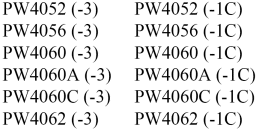
On each airplane, each engine's model designation must be established. Listed below are the model designations as they appear on the dataplate for engines with a hardware configuration that includes an FB2C (Phase 3) fan. Unless all engines on a particular airplane have been confirmed to have FB2C (Phase 3) fans, the performance adjustments will apply.
PW4000 Engine Dataplate Model Designations For Engines With FB2C (Phase 3) Fans which are NOT Affected by the Thrust Shortfall:
Operating Instructions
The following airplane performance adjustments apply when operating with one or both engines which are not equipped with FB2C (Phase 3) fans.
Reduce Long Range Cruise Maximum Operating Altitude by 800 ft.
Reduce Engine Inoperative Altitude Capability for all speeds by 1500 ft.
Reduce Gear Down Long Range Cruise Altitude Capability by 1400 ft.
Reduce Engine Inoperative Gear Down Long Range Cruise Altitude Capability by 2000 ft.
Increase Driftdown/LRC Cruise Range Capability fuel required by 2%.
Operations Manual Performance Inflight (PI) Chapter and FMC performance numbers should be adjusted accordingly.
Administrative Information (Extract)
This Operations Manual Bulletin will remain in effect as long as 767 Airworthiness Directive AD 2001-01-10 is effective. Application of the information contained herein may change if and when alternate means of compliance with the AD are granted.