Air Systems - Pressurization
Amendment: Non-Normal Indications amended.
- QRH - CABIN ALTITUDE or RAPID DEPRESSURISATION
- Limitations - Fire Protection
- Flight Safety Foundation - Surviving Cabin Decompression 52Kb
Introduction
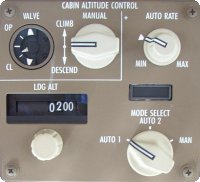
Cabin pressurization is controlled by adjusting the discharge of conditioned cabin air through the Outflow Valve.
Positive pressure relief valves and Negative Pressure Relief Doors protect the fuselage from excessive pressure differential.
The pressurization system has automatic and manual operating modes.
 |
 |
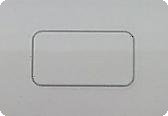 |
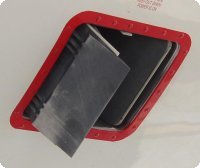
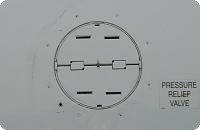
| Outflow Valve | Positive Pressure Relief Valve(s) |
Negative Pressure Relief Door(s) |
|---|
Pressurization System Automatic Operation
Auto 1 / Auto 2
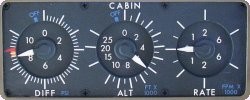 In automatic, two identical but independent systems are provided for cabin pressure control. Each uses a separate AC bus and motor for outflow valve operation. The auto controllers receive required inputs of Cabin Pressure, Air/Ground Logic, Barometric corrected altitude and Thrust Lever position.
The pressurization system is in the automatic mode when the Cabin Altitude Mode Selector is set to AUTO 1 or AUTO 2. If the selected auto mode fails, control is automatically switched to the other auto mode.
In the automatic mode, the pressurization system uses ambient pressure data from the Air Data System in conjunction with the selected Cabin Auto Rate (set on the Cabin Altitude Auto Rate Control), the takeoff altitude and the indicated landing altitude, entered using the Landing Altitude Selector, to calculate the cabin pressurization schedule.
Failure of either AUTO 1 or AUTO 2 results in an associated CABIN ALT AUTO 1/2 EICAS status message.
Cabin Auto Rate Control
The selected altitude AUTO RATE, in sea level feet per minute, determines cabin climb and decent rate limits. An index mark on the control indicates a setting for 500 feet per minute climb and 300 feet per minute descent. These limits can be decreased or increased by rotating the selector towards MIN or MAX. During automatic pressurization the cabin climbs at a rate proportional to the airplane rate of climb. The cabin descends at no more than the rate set on the Auto Rate Control until the selected landing altitude or 8.6 psi differential pressure is reached. If 8.6 psi is reached the landing altitude, 8.6 psi is held until the cabin is at landing altitude.
Landing Altitude Selector
The Landing Altitude Selector controls the numerical indication of the Landing Altitude Indicator. Landing Altitude settings of -1000 to 14,000 ft may be made. Landing altitude inputs to the cabin altitude controllers are used to establish the proper pressurization for landing. During Auto operation, the cabin descends to an altitude slightly below the landing altitude so the cabin is pressurized at touchdown.
Takeoff
For takeoff, the system supplies a small positive pressurization to cause a smooth cabin altitude transition. This is achieved by descending cabin altitude slightly below the takeoff airport elevation and occurs when both Thrust Levers are advanced beyond 10° (with both engines running).
Climb
During climb, cabin altitude increases on a schedule related to the takeoff field elevation, airplane altitude and the selected Auto Climb Rate Limit. For each airplane altitude there is a corresponding cabin altitude.
If the maximum cabin pressure differential is reached (8.6 psi at approximately 35,000 ft), cabin climb rate becomes a function of airplane climb rate, while maintaining the maximum differential pressure.
1. When operating from airfields with a relatively low elevation (sub 1000 ft).
Cruise
Shortly after the airplane levels off (altitude remains constant for one minute), the system enters the cruise mode. The landing altitude and the scheduled cabin altitude are compared and the higher of these two is selected for the cruise cabin altitude. If necessary, the cabin climbs to the cruise cabin altitude at one-half the auto rate or descends to the cruise cabin altitude at the auto rate.
The cruise cabin altitude does not change for minor altitude variations. A significant altitude change causes the system to re-enter the climb mode (if cruise altitude increases by more than 500 ft) or to enter the descent mode (if cruise altitude decreases by more than 1000 ft).
Descent and Landing
During descent, cabin altitude decreases to slightly below (approximately 100 ft) the selected landing altitude. This ensures that the airplane lands pressurized. Landing altitude barometric pressure correction comes from the captain's altimeter.
If the airplane levels for more than 1 minute after descent is established, cruise mode will re-establish.
At touchdown (as signalled by Air/Ground Logic), the outflow valve opens (at a controlled rate) to depressurize the aircraft.
After landing, the pressurization system automatically conducts a self test of the alternate controller.
Non-Normal Indication
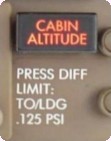 HI ALT LDG If the cabin altitude climbs above 10,000 ft (14,650 ft with HIGH ALT LDG switch ON), the CABIN ALT and CABIN ALTITUDE lights illuminate and the EICAS warning message CABIN ALTITUDE displays. The lights extinguish and the EICAS message blanks when the cabin altitude descends below 8,500 ft (11,800 ft with HIGH ALT LDG switch ON).
Failure of either AUTO 1 or AUTO 2 results in an associated CABIN ALT AUTO 1/2 EICAS status message.
Auto INOP Light
 The AUTO INOP light illuminates and the EICAS caution message CABIN AUTO INOP displays when the automatic pressurization control (both AUTO 1 and AUTO 2 Cabin Altitude Controllers) fails or when the cabin altitude MODE SELECT is in MAN. A failure of both auto controllers causes the outflow valve to freeze in its last controlled position. The valve remains in that position until manual control is established. Manual operation is required if the automatic system fails.
Positive pressure relief valves and negative pressure relief valves operate independently from the pressurization control system to protect the fuselage against excessive pressure differential.
MEL Both Auto Cabin Pressure Control Systems may be inoperative provided:
- Flight is conducted in an approved unpressurized configuration.
- Lower Cargo Compartment remains empty or only non-combustible materials are carried.
Both the automatic and manual modes are equipped with aneroid switches that automatically close the outflow valve when the cabin altitude exceeds 11,000 ft (14,500 ft with HIGH ALT LDG switch ON).
Only the automatic mode is equipped with an aneroid switch that automatically close the outflow valve when the cabin altitude exceeds 11,000 ft (14,500 ft with HIGH ALT LDG switch ON). The manual mode has no auto closure function.
When cabin altitude descends below 9,500 ft, the aneroid switch(es) open and the outflow valve circuits are restored.
Any decrease in the cabin air inflow that causes a deviation from the normal pressurization schedule and results in cabin altitude attempting to climb higher than programmed, results in the outflow valve closing. If the valve does not operate automatically, manual control must be used to close the valve.
Manual Operation
In the manual mode, all automatic functions of the cabin pressure control system are locked out.
The Cabin Altitude Manual Control operates a DC motor using power from the Standby DC Bus to open and close the outflow valve. Manual control positions - CLIMB and DESCEND - signal the valve to move towards Open or Close. The Outflow Valve Position Indicator shows relative valve position and can be used to determine movement during manual control.
To operate the pressurization system manually:
Set the cabin altitude MODE SELECT to MAN.
Hold the cabin altitude MANUAL control to CLIMB to move the outflow valve towards open and cause the cabin altitude to climb.
Hold the cabin altitude MANUAL control to DESCEND to move the outflow valve toward closed and cause the cabin altitude to descend.