Boeing Bulletins
GEN-100 : 757-300 Proximity Sensing Electronic Unit (PSEU) Fault
12 December 2008
Effectivity
Reason
To provide information regarding recognition of a PSEU software fault and to provide flight crew temporary operating instructions when the fault exists.
Background Information
Boeing and Crane Aerospace Electronics (CAE) have confirmed operator reports of a specific software fault mode within the 757-300 Proximity Sensing Electronic Unit (PSEU). The PSEU provides on-ground and in-flight position sensing and control logic to various airplane systems. The PSEU contains two redundant and independent system cards designated as System 1 and System 2. Boeing has confirmed the PSEU software fault affects the following airplane systems:
- Automatic Speedbrake extension
- Thrust reverser deployment
- Ground Proximity Warning System (GPWS).
When the PSEU fault is active in either the System 1 or System 2 cards, the illumination of each of the green Landing Gear Down Lights (NOSE, LEFT, and RIGHT) is affected. Each green light is illuminated by two light bulbs. The left light bulb is powered from the System 1 card, and the right light bulb is powered from the System 2 card. Therefore, flight crew recognition of the PSEU fault is provided by each of the green Landing Gear Down Lights (NOSE, LEFT, and RIGHT) anytime the landing gear is extended.
Figure 1, shown below illustrates normal illumination of the NOSE, LEFT, and RIGHT green Landing Gear Down Lights:
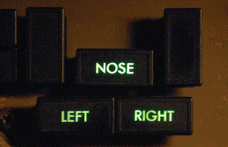
Figure 2, shown below illustrates the reduced illumination in the left portion of each of the NOSE, LEFT, and RIGHT green Landing Gear Down Lights, which results when the PSEU software fault exists in the System 1 card:
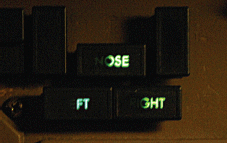
Figure 3, shown below illustrates the reduced illumination in the right portion of each of the NOSE, LEFT, and RIGHT green Landing Gear Down Lights, which results when the PSEU software fault exists in the System 2 card:
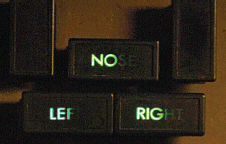
This PSEU software fault should not be considered active unless reduced illumination, as illustrated in either Figure 2 or Figure 3 above, is observed in all green Landing Gear Down Lights. The fault can occur when the airplane is in flight with the landing gear extended or on ground. Verification of green Landing Gear Down Lights illumination status can be confirmed by accomplishing the Indicator Lights Test Supplementary Procedure.
Boeing has confirmed the PSEU software fault in the System 1 card, as illustrated in Figure 2 above, will result in:
- automatic speedbrake extension being inoperative
- left thrust reverser being inoperative
- the GPWS "TOO LOW GEAR" voice aural alert occurring accompanied by illumination of the amber GND PROX light on the forward panel when at or below approximately 190-knots CAS during approach.
Conversely, the PSEU software fault in the System 2 card, as illustrated in Figure 3 above, will result in:
- automatic speedbrake extension being inoperative
- right thrust reverser being inoperative.
Operators are advised Boeing and CAE are continuing to investigate the source of the PSEU software fault. To date, the effects of the software fault as described above are the only operator reported effects Boeing and CAE have been able to confirm. Boeing encourages operators to continue reporting all in-service events related to the PSEU fault described in this Flight Crew Operations Manual Bulletin providing as much event detail as possible.
Operating Instructions
Upon flight crew confirmation of the PSEU software fault active as illustrated in Figure 2 or Figure 3 above, the following temporary operating instructions are provided:
If on ground, do not takeoff until a maintenance disposition has been accomplished. Maintenance disposition will clear the PSEU fault for flight and provide normal illumination of the green Landing Gear Down Light, as illustrated in Figure 1 above.
If in flight, consult the applicable Normal Configuration Landing Distance (NCLD) advisory information chart contained in the Performance Inflight section of the Quick Reference Handbook (QRH). The NCLD advisory information chart provides the landing distance adjustment for one thrust reverser inoperative and manual speedbrake extension.
Then, accomplish the normal Landing Roll Procedure, as published, but manually move the speedbrake lever to the UP position after main gear touchdown and extend only the operable reverse thrust lever. And, if the PSEU System 1 software fault is confirmed (see Figure 2 above), the GPWS "TOO LOW GEAR" voice aural alert accompanied by the amber GND PROX light will occur when airspeed is at or below approximately 190-knots CAS. If the "TOO LOW GEAR" voice aural alert is not accompanied by any other landing gear extension related alert message or light, the "TOO LOW GEAR" voice aural alert may be disregarded.
Administrative Information (Extract)
Boeing Maintenance Tip 757 MT 32-025 is related to this Flight Crew Operations Manual Bulletin (FCOMB).
The corrective action for the fault described in this Flight Crew Operations Manual Bulletin is still under investigation. This bulletin remains in effect until further notice and will be revised to include service bulletin information, when available.